
Sit-to-Stand Lifts
A sit-to-stand lift helps a person move from sitting to standing, then transfer safely between surfaces like a bed, a wheelchair, or a commode.
It’s a practical option for someone with some leg strength who can’t rise or transfer on their own, and it takes a lot of the strain off the caregiver too.
At Conval-Aid, you can buy or rent a range of lifts right here in Ottawa, and our product experts will help you match the lift to the person who’ll use it.
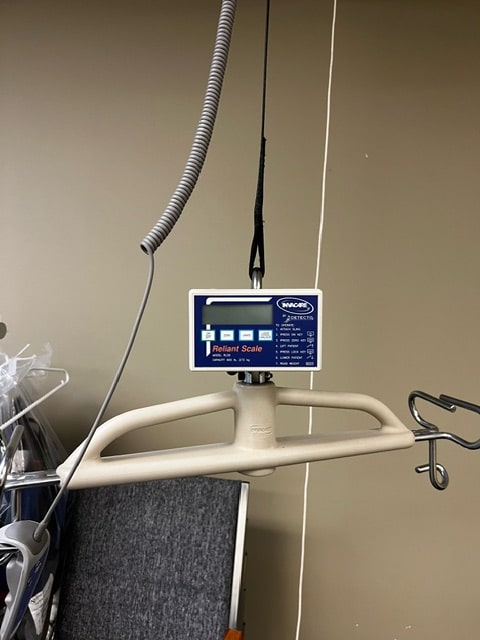
Try Our Free Lift Weight Scale
Choosing the right lift starts with the right weight capacity.
That’s why we keep a 1,000lb roll-on weight scale right in our showroom that you’re welcome to use, free of charge. Simply roll on for an accurate reading to know which capacity range to shop in, saving a lot of second-guessing later.
Buy or Rent a Sit-to-Stand Lift
Not every need is permanent, so we offer both options.
- Buying: makes sense for long-term or permanent needs, when a lift will be part of daily care for the foreseeable future.
- Renting: ideal for post-surgery recovery, short-term rehab, respite care, or simply trialling a lift before you commit to buying one.
There’s no single right answer, and the best choice often depends on how your situation is expected to change over time. Tell us what you’re working with, and we’ll help you decide whether buying or renting fits better.
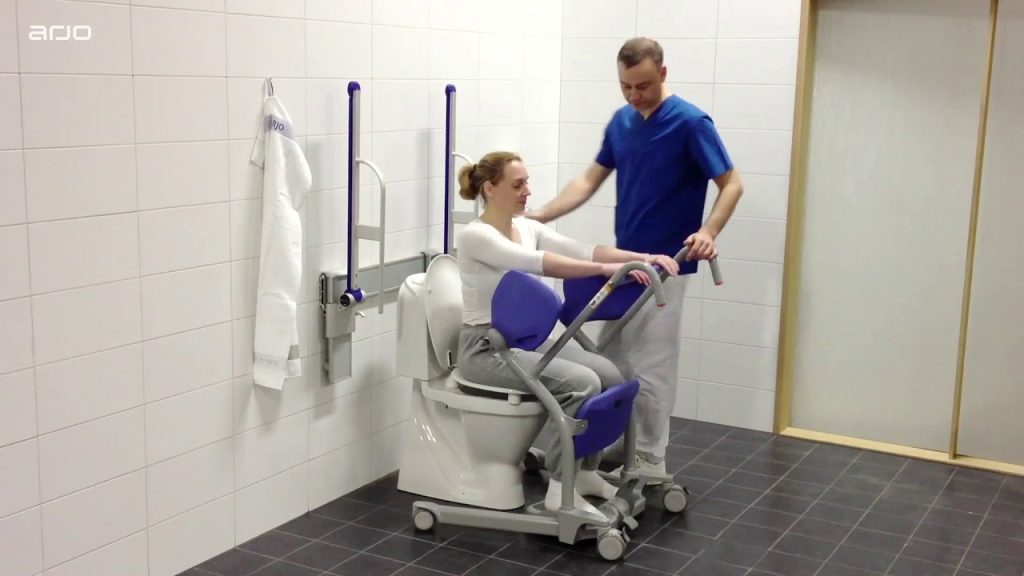
Sit-to-Stand Lifts We Carry
Here are three models we carry, from a compact home lift to a higher-capacity powered unit.
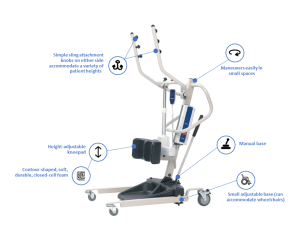
Invacare Reliant RPS350 Stand-Up Lift
- Best for: Everyday home and facility transfers where a dependable powered lift is the priority.
- Weight capacity: 350 lb
- Powered or manual: Powered lifting, with a manual or powered base (both model options available)
- Dimensions:
- Base length: 36.5″
- Base width: 26” (closed) to 37″ (open)
- Sling hook-up height: 39.6” to 63.7”
- Standout feature: Two removable batteries are included, so one can charge while the other is in use. Each delivers roughly 100 to 200 lifts per charge.
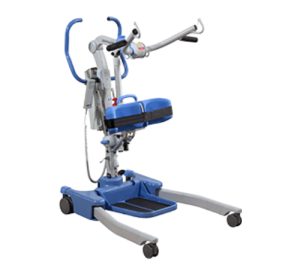
Hoyer Journey
- Best for: Home use and smaller spaces, including households that need to fold and store the lift or move it between rooms.
- Weight capacity: 341 lb
- Powered or manual: Powered
- Dimensions:
- Base length: 36.8″ (min) to 39.4” (max)
- Base width: 27” closed to 38.2” open
- Sling hook-up height: 28.4” to 60.2”
- Standout feature: Smart Monitor technology that tracks usage and the lift’s longevity.
Span F500S Powered Sit-to-Stand Patient Lift
- Best for: Heavier users and anyone who wants the smoothest powered transfer with the most safety features.
- Weight capacity: 500 lb
- Powered or manual: Powered
- Dimensions:
- Base length: 46.9”
- Base width: 26.4”(closed) to 39.3” (open)
- Lifting height with spreader bar: 21.5” to 68.6”
- Standout feature: Safety is prioritized with overload protection using a visual and audible alert, and manual emergency lowering if capacity is exceeded.
Ready to get started?
Give us a call at 613-738-2721 or contact us online. Our specialists will be happy to help you with any questions you may have.
How to Choose the Right Sit-to-Stand Lift
Once you know a sit-to-stand lift is the right type, these are the factors that separate one model from another. If you’re weighing other lift styles too, our roundup of the best patient lifts is a helpful next read.
Powered lifts give smooth, low-effort transfers and are more practical for heavier users. Manual and stand-assist lifts are lighter, more portable, and lower in cost, which can be the better call for lighter users or occasional use.
At minimum, match the rating to the user. Standard models commonly land around 350 to 400 lb, with higher-capacity options above that.
Check base clearance, your smallest doorway width, and how the lift handles on carpet, especially if it needs to travel between rooms.
A handheld remote is easy to position during a transfer, while a fixed panel keeps everything in one spot. Think about who’s operating it and where.
A swappable battery means no downtime, while a plug-in charging setup is simpler if the lift stays in one place.
Ask about parts, sling replacement, and the support you’ll get after the sale. Our experienced service technicians maintain and repair lifts long after purchase.
What Is a Sit-to-Stand Lift?
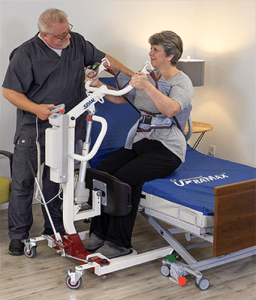
A sit-to-stand lift is a device that helps a person rise from a seated position and transfer between surfaces, such as bed to wheelchair, or wheelchair to commode.
The user sits on the edge of a surface, places their feet on a footplate, and rests their shins against a padded knee support. A sling wraps around their back and under the arms, and the powered or manual lifting action brings them up into a supported standing position for the transfer.
These devices are for people who can bear some weight through their legs and stay upright with support. In contrast, a full-body Hoyer lift cradles the whole body in a sling and is meant for people who can’t bear weight at all.
Who Is a Sit-to-Stand Lift For?
A sit-to-stand lift is a safety decision as much as a mobility one.
Falls cause 89% of injury-related hospitalizations among adults 65 and older, with 78,076 fall-related hospitalizations in 2022 (excluding Quebec) and about 34% involving a hip fracture.
Matching the lift to the user’s ability is what lowers that risk, so it’s a good fit for people who:
- Have some leg strength but can’t stand safely on their own
- Can sit upright on the edge of a bed without support
- Can follow simple instructions during a transfer
May not be suitable for people who:
- Can’t bear any weight through their legs
- Have significant knee pain or active leg injuries
- Have poor trunk, head, or neck control
If a sit-to-stand lift isn’t the right fit, a full-body lift usually is, and we can help you set up other mobility and bedroom aids to make daily transfers safer.
If you’re not sure which way to go, book an assessment with one of our product experts, and we’ll sort it out together.
Frequently Asked Questions
A sit-to-stand lift is for people who can bear some weight through their legs and stay upright with support, and it helps them rise and transfer while partially standing. A full-body Hoyer lift cradles the entire body in a sling and is for people who can’t bear weight at all.
In many cases, yes. Powered sit-to-stand lifts are designed so a single trained caregiver can manage a transfer, provided the user is a good fit for this type of lift.
The final cost varies with the type, weight capacity, and features, so it’s best to get a quote for the specific model and setup you need.
Yes. We rent sit-to-stand lifts, which is a great option for post-surgery recovery, short-term rehab, respite care, or trialing a lift before you buy.
It depends on the model. Standard lifts commonly hold around 350 to 400 lb, and higher-capacity models go to 500 lb and beyond.
Funding & Coverage in Ontario
The right funding can make a lift far more affordable, and the paperwork is easier with someone in your corner.
- Ontario Assistive Devices Program (ADP): For eligible Ontario residents, the Assistive Devices Program may cover a portion of the cost of a patient lift. Eligibility and the covered amount depend on the program’s current criteria.
- Other programs: Depending on your situation, support may also come through March of Dimes Canada, Veterans Affairs Canada, or WSIB.
Funding rules can change, and every situation is a little different. Ask us any questions, and we’ll help you understand what you may qualify for and how to navigate the paperwork.
Visit Our Ottawa Showroom or Book an Appointment
The best way to choose a sit-to-stand lift is to try it out first.
Come see us at our Ottawa showroom, test the models side by side, and use our free weight scale while you’re here.
- Showroom: 2600 Lancaster Road, Ottawa
- Phone: 613-738-2721
- Hours: Monday to Friday, 9 AM to 4 PM
For the best experience testing different lifts, we recommend booking an appointment with one of our dedicated product specialists.
Here’s what to expect at your appointment:
- One of our product specialists will ask about the user’s strength, mobility, and living space
- They’ll share the models that fit, and help you compare buying versus renting.