
For Ontario families, the search for mobility equipment feels like it has only two extremes: standard retail strollers that lack proper support, or full-sized pediatric wheelchairs that feel overwhelming for everyday errands.
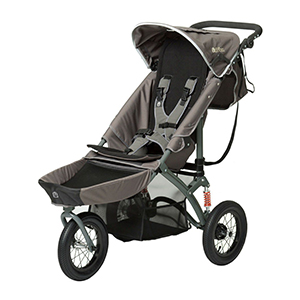
Adaptive strollers are designed to bridge that gap, offering medical-grade postural support in a discreet, family-friendly design that blends into everyday outings rather than standing out.
According to the 2024 Fifth Annual Report of the Disability Advisory Committee, and further emphasized in a report on the 2021 Canadian Census, over 16% of Canadian children aged 0 to 14 experience a disability.
At Conval-Aid Kids, we carry a curated selection of top-tier pediatric mobility equipment, which you can preview directly on our Pediatric Order Form.
Continue reading for a closer look at what to consider and which models might be the best fit for your family.
Table of Contents
What to Consider When Choosing an Adaptive Stroller
Choosing the right adaptive stroller means thinking about how it fits into your family’s daily life, not just your child’s clinical needs.
In Ontario, where we deal with everything from narrow store aisles to heavy slush on the sidewalk, these factors are critical:
1. Level of Postural Support
Does your child need simple harness support to sit upright, or do they require more complex positioning?
Some children need tilt-in-space features to help with pressure relief and digestion, while others require specialized head support or lateral trunk supports.
It is essential to distinguish between basic posture support and clinical-level seating that provides the same support as a high-end pediatric wheelchair.
2. Terrain and Lifestyle
Next, consider where you will actually use the stroller.
If you spend your time in shopping malls or school hallways, a compact umbrella-fold model is your best friend.
However, if your weekends involve Ontario’s beautiful hiking trails or navigating snowy sidewalks in the winter, you will want a model with rugged tires, advanced suspension, and a larger wheel diameter to handle uneven ground.
3. Foldability and Transport
For many families, the stroller needs to fit into the trunk of a standard car. You should look for a “quick-fold” mechanism that is easy for a single caregiver to handle.
If your child requires a more complex seating system that doesn’t fold as compactly, you may need to consider if your current vehicle has the necessary space or if an accessible vehicle is required for transport.
4. Funding and Insurance in Ontario
Adaptive equipment is an investment, but you don’t have to navigate it alone.
Ontario families often qualify for the Assistive Devices Program (ADP), which can cover up to 75% of the cost for eligible equipment. Additionally, organizations such as Easter Seals Ontario or other charitable grants can help bridge the gap for the remaining 25%.
Private insurance may also offset the costs. Our team can walk you through the available funding and grants, along with the paperwork needed to ensure you receive the maximum available support.
The Best Adaptive Strollers on the Market
The following models represent the “gold standard” in pediatric mobility. Each serves a different lifestyle need, from active outdoor use to clinical-grade positioning.
Adaptive Strollers Comparison
| Stroller Model | Best For | Growth Adjustability | Standout Feature |
| Jogger | Active families, outdoor terrain | Adjustable harness & recline | Three-wheel design with rugged pneumatic tires |
| Bingo Evolution | Complex positioning needs | Adjusts across 4 different sizes | 45° tilt-in-space with adaptive suspension |
| Convaid (Cruiser / EZRider) | Everyday transport, school | 5 years of built-in seat growth with the seat extension (Cruiser only) | Umbrella-style fold; lightweight & transit-ready |
| Voyage (Zippie) | Early intervention for infants | Growth-compatible seating tiers | Reversible seat for face-to-face interaction |
A Closer Look at Our Top Picks
The Jogger
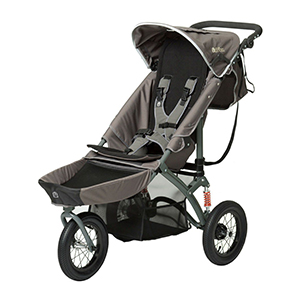
The Jogger is built for families who refuse to let a disability slow them down. Its three-wheel design and rugged pneumatic tires handle grass, gravel, and snowy sidewalks with ease.
For parents who enjoy nature walks or jogs, this model lets you include your child in every adventure. The reclined seating angle keeps riders balanced and comfortable, even when moving over bumpy ground.
The Bingo Evolution (Thomashilfen)
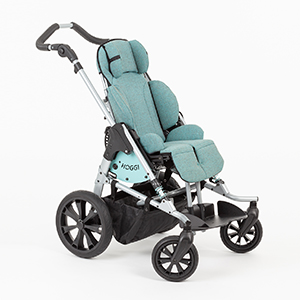
The Bingo Evolution is a German-engineered rehab pushchair designed for children with more complex medical needs. It offers 45° of tilt-in-space and a backrest that reclines up to 160°.
What sets it apart is the four-setting adaptive suspension system that absorbs shocks, making it ideal for long days out. The seat is reversible and comes in four sizes that grow with your child through adolescence.
The Convaid (Cruiser & EZRider)
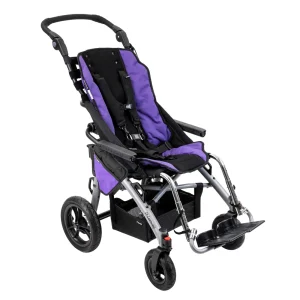
These are the go-to choices for families who need a “grab and go” solution. Both fold like a standard umbrella stroller into a remarkably compact package.
- EZRider: Features a 10° fixed tilt, perfect for children with good upper-body control who want to be active and engaged with their surroundings.
- Cruiser: Offers a 30° fixed tilt for children who need more postural support or “cocooning” to reduce overstimulation.
Both models include Convaid’s Self-Tensio® seating system and are available with a WC19 transit package, making them safe for school bus transport.
The Voyage (Zippie)
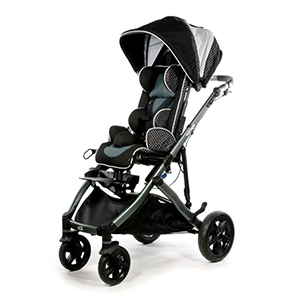
The Voyage combines modern stroller aesthetics with high-level clinical seating.
Developed with Baby Jogger, it features a reversible seat. This is a major benefit for parents of younger children who need face-to-face visual contact for medical monitoring or emotional reassurance.
It offers two seating tiers (Moderate and Advanced) to ensure the support matches your child’s needs as they grow.
Frequently Asked Questions
What is the difference between an adaptive stroller and a pediatric wheelchair?
Adaptive strollers are designed to be pushed by a caregiver and prioritize a discreet, “stroller-like” appearance and ease of folding. Pediatric wheelchairs are typically built for self-propulsion and may offer even more granular seating adjustments. For many, the stroller is the preferred choice for community outings and transport.
Are adaptive strollers crash-tested for school buses?
Many of the models we carry, including the Convaid Cruiser and Bingo Evolution, are available in WC19-compliant configurations. This means they have been crash-tested and are approved for use with vehicle tie-down systems on school buses and accessible vans.
How do I know what size adaptive stroller to buy?
Getting the right fit is a clinical process, not a guessing game. It requires precise measurements of hip width, seat depth, and lower leg length. For more guidance on this process, check out our Buyer’s Guide to Pediatric Equipment.
Next Steps: Let Conval-Aid Help You Find the Perfect Fit

Choosing an adaptive stroller doesn’t mean giving up your family’s active lifestyle; it’s about finding the right tool to enhance it.
Don’t guess on sizing or support levels. Book an appointment at Conval-Aid to have your child professionally measured and fitted by our pediatric specialist, Luc Perron.
Browse our Pediatric Order Form to see our full lineup of adaptive strollers and accessories before your visit.
Call us today: 613-738-8694 (ex. 203)