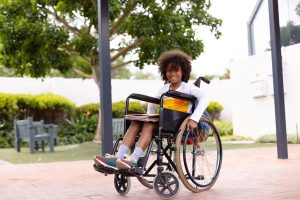

When your parent can no longer get out of their chair, the search for the best lift chairs for seniors is really about helping them continue living independently at home.
The three things to consider are the cost, whether it’s comfortable for long hours, and whether it actually fits the person sitting in it.
The best chair is the one that fits that specific user, not the one with the longest feature list. At Conval-Aid, we carry four lift chair lines at our Lancaster Road showroom.
Book an appointment to test our lift chairs, or call us at 613-738-2721, and we’ll talk it through first.
Table of Contents
The Four Lift Chairs We Recommend Most
Of all the available brands and models, these fit the most people, and most clients end up with one of them.
Pride Power Lift Recliners
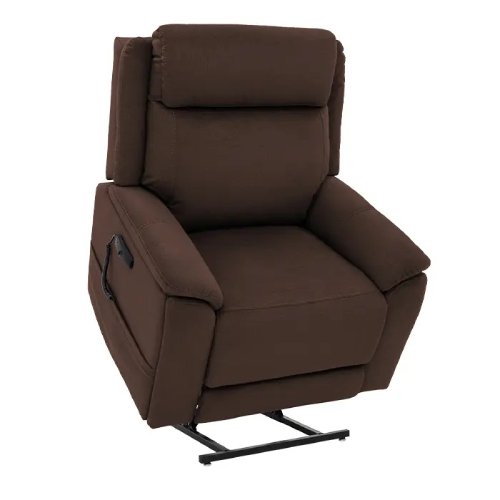
The Pride Power Lift recliner line covers a wide range of budgets and body sizes.
The Genesis LC-150 is the straightforward starting point: 325 lb weight capacity in Small and Medium. The Muskoka LC-475 sits in the middle; users up to 400 lb across Small, Medium and Large, and it adds a power headrest, power lumbar and a standard footrest extension.
The Evolution LC-435 offers sizes from Small and Petite/Wide through Extra Extra Large, with capacity increasing from 400 lb to 500 lb in Extra Large and to 600 lb in Extra Extra Large.
The trade-off with this line is comfort features. There’s no heat or massage, although the Muskoka and Evolution both have built-in USB-A and USB-C charging ports.
Pride VivaLift!
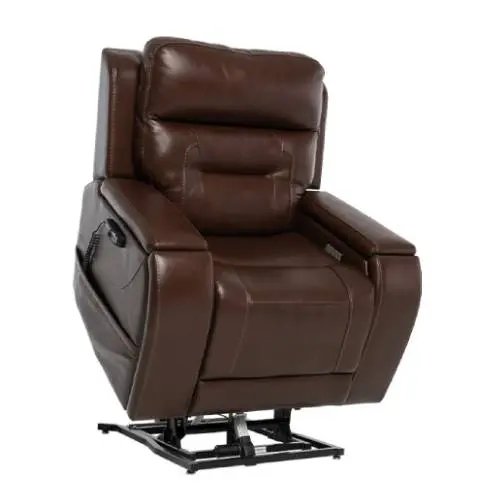
If someone’s going to spend multiple hours per day in the chair rather than just using it to stand up, the VivaLift! line is a great option.
This line features seven models. The Ultra’s Weightless Tilt and the Premier’s VivaLift! Tilt both recline the chair until the knees sit above the heart, which is where that weightless feeling comes from, and those two are also the only ones with the air bladder massage system.
Heat pads in the shoulders, lumbar, and seat are included on the Ultra, Premier and Radiance, along with a hideaway wireless phone charger. Lower down the line, the Elegance 2 and Metro 2 trade those extras for power headrest, backrest and lumbar adjustment.
The two main considerations are that you might pay for features an occasional user never touches, and VivaLift! chairs support up to 400 lb, so a heavier user is better served by the Power Lift line above.
Golden Technologies
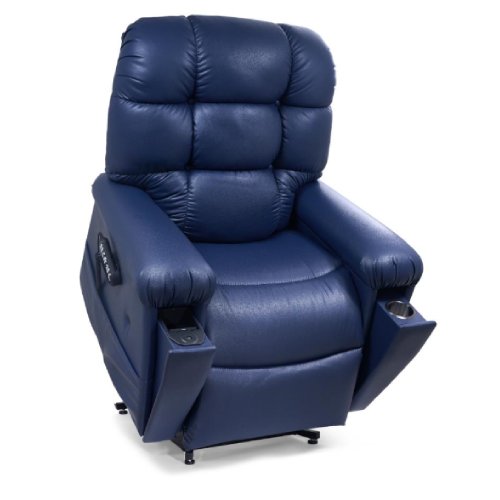
Golden is the line to look at when individual details really matter.
The organizing idea is the Comfort Zone. A one-zone chair positions the lower body; a two-zone chair sets the back and legs independently; and four-zone and five-zone chairs add head and back support, all of which are adjusted via the AutoDrive hand control.
Many models add patented Twilight tilt-in-space, which tilts the seat and back as a single unit rather than opening the hip angle.
There are about 20 different models, and across them, the sizes, weight capacities, accommodated heights and widths, fabrics, and even the padding thickness in individual sections all vary. Features vary in the same way, from a standard chair lift and recline up to hideaway drink holders, eating trays and charging ports.
The varying features are the trade-off. Golden lift chairs are harder to learn and harder to shop for on a screen, so picking one usually means narrowing it down in person.
Accora Configura Solus
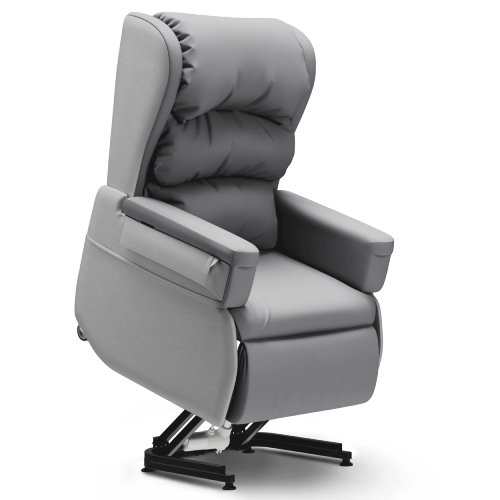
The Configura Solus is a specialist lift chair we point customers to when comfort isn’t the whole problem.
Seat width, depth, and height each adjust from 16 to 22 inches without tools, so the chair is highly adjustable to the user. The back reclines from 95 to 125 degrees, with roughly 28 degrees of true tilt-in-space, and the leg rest elevates independently.
Pressure care is standard: vapour-permeable fabric on the contact surfaces and a high-risk visco foam cushion. It carries up to 348 pounds and can be moved from room to room on transport casters.
The Configura Solus is the right answer for custom positioning or pressure management, but is designed more for a clinical setting than a living room.
Lift Chair Comparison at a Glance
Now that we’ve covered all four, let’s compare them side by side on the points customers value most.
| Feature | Pride Power Lift | Pride VivaLift! | Golden Technologies | Accora Configura Solus |
| Best for | Most buyers, across budgets and sizes | Long daily sitting hours | Matching an exact size, fabric and feature set | OT-led positioning and pressure care |
| Position type | 2-position through infinite by model | Infinite on most models | 1, 2, 4, or 5 Comfort Zones | Tilt-in-space with independent recline |
| Standout feature | Size and budget range | Weightless Tilt on the Ultra and Premier | AutoDrive control and Twilight tilt | Toolless 16 to 22 inch seat sizing |
| Sizing (Varies by model) | Small and Petite/Wide to Extra Extra Large | Small to Large/Tall | Six sizes on the MaxiComforter, two extra-wide | Fully adjustable to the user |
| Weight capacity (Varies by model) | 325 lb to 600 lbs | Up to 400 lb | 400 lb to 600 lbs | 348 lbs |
| Sleeps in chair | On infinite-position models | Yes on most | Yes, Sleep and Zero Gravity positions | Not designed for it |
| Trade-off | Fewer comfort features | Features an occasional user won’t use | Harder to learn controls, many variations to shop online | Clinical, not living room furniture |
What Makes a Lift Chair the “Best” for a Senior
The best lift chair for a senior depends on price, comfort over long sitting hours, and accessibility, meaning fit, reach, and controls the user can actually operate.
The most useful question to answer first is, “How many hours a day will the chair be used?” An hour of evening TV and ten hours of daytime sitting are very different problems, requiring different solutions.
That’s also why spec-sheet shopping fails. Seat depth and width are body measurements, not preferences, and no feature list tells you whether a seat is two inches too deep for the person who’ll be in it.
Adapting a home this way is common: home adaptations are the most common support older Canadians use to stay in their own homes, at 25.0% of those aged 65 to 79 and 51.9% of those 80 and older, according to the Canadian Health Survey on Seniors.
Lift Chair Positions Explained
Almost every lift chair you’ll be shown falls into one of three types, and the difference is in its adjustability.
2-Position
Upright and a partial recline, with the back and footrest linked on a single motor. Lowest cost, smallest footprint, and fine when the chair is mainly a seat someone needs help getting out of.
3-Position
The same single-motor arrangement, but it reclines close to flat. The sensible choice for a daily user who naps in the chair.
Infinite-Position
Two motors, so the back and legs move independently. That’s what allows a true lay-flat position, legs above the heart, and zero gravity. Choose it when circulation, edema, or recovery from surgery is the driving factor in the purchase.
Whichever you land on, the lift itself does the important work. Falls account for 89% of injury-related hospitalizations among Canadians aged 65 and older, and 34% of fall-related hospitalizations involve a hip fracture, based on 2022 data (excluding Quebec).
The key takeaway is that the sit-to-stand transition is where fall risk is concentrated, and a lift chair takes the effort out of that moment.
Sizing: The Part Most Buyers Get Wrong
Six factors decide whether a chair is the right choice for a user. Filter your choices using these before getting too attached to a specific model.
- Seat depth. Knees bend right at the front edge, with 2 to 4 inches of clearance behind the knee.
- Seat width. Two to three inches of clearance at the hips, no more. Extra width leaves the user unsupported sideways.
- Seat height. Feet flat on the floor, not dangling.
- Armrest height. Forearms resting, elbows near 90 degrees.
- Weight capacity. Match it to the user, and size up if they’re near the top of a rating.
- Wall clearance. Infinite-position chairs need real room behind them, so measure first.
What a Lift Chair Costs & What Reduces It

Pricing varies widely based on the line, size, position type, fabric, and features. However, a two-position chair is typically considered entry-level; a three-position model costs more; and infinite-position and specialist seating are at the top of the price range.
Here are programs that can potentially reduce what you pay. If you need a written quote, we can provide one. Call us at 613-738-2721, and we’ll price the lift chair you’re considering.
GST/HST Relief on Prescribed Lift Chairs
A lift chair can be zero-rated for GST/HST. The CRA’s guidance on applying GST/HST to lift chairs sets out the conditions: the chair must have a lifting mechanism, be specially designed for a person with a disability, and be supplied on the written order of a physician, physiotherapist, occupational therapist, or registered nurse.
The Medical Expense Tax Credit
A prescribed lift chair may also be claimable. Lift chairs aren’t a named line item, but the CRA’s list of eligible medical expenses includes power-operated chairs and power-operated lift equipment, both prescription-required with no certification form. Remember to keep the prescription and the receipt together.
Veterans Affairs Canada
If the person who’ll use the chair is a veteran, check with Veterans Affairs Canada before you buy. Eligibility depends on the veteran’s service and health circumstances, not on the chair itself, so ensure you verify the item’s eligibility on the Treatment Benefits page.
Private Extended Health Plans
Some employer and private extended health plans reimburse part of the cost, usually with a doctor’s note and sometimes only on specific models. Check your plan’s wording regarding durable medical equipment or home medical equipment, and obtain written approval before ordering.
The Ontario Assistive Devices Program
Unfortunately, lift chairs are not funded by the Assistive Devices Program. It specifically excludes chair lifts and lifting devices.
If the broader need includes equipment ADP covers, such as a wheelchair, walker, or scooter under mobility aids, that route runs through an ADP-registered authorizer, and we can point you to one.
Buy vs. Rent Lift Chairs
Buy when the chair will be part of daily life for the foreseeable future. You own it, you get the manufacturer’s warranty, and the full range of lines and sizes is open to you.
Rent for a shorter window: recovery after a hip or knee replacement, a stretch of rehab, respite care, or trying a chair for a few weeks before committing.
Interested? Ask us what’s available through our rentals, and we’ll tell you what it costs.
Why Try Before You Buy Lift Chairs
Two chairs can look nearly identical online, and feel completely different within seconds of sitting down.
Seat firmness, the angle the lift stops at, where the lumbar support lands on your back: all of this decides whether someone uses the chair happily for years.
Our specialists aren’t on commission, so the conversation stays genuine. We also service everything we sell with experienced in-house service technicians, which matters for powered furniture used several times a day.
Family-owned since 1976, our showroom at 2600 Lancaster Road is open Monday to Friday, 9 AM to 4 PM.
Test Lift Chairs in Person Today
Bring the person who’ll be using the chair if you can. Ten minutes of them testing a few models tells us more than any measurement we could take, and it’s usually the easiest way to decide on a lift chair they’ll love.
Book an appointment, or reach us at 613-738-2721 or toll-free at 1-800-267-8883. We’re here to help. Just ask!